More talented lawyers are looking beyond the traditional partnership track to build careers that offer greater autonomy, flexibility, and earning potential. Working as a consultant lawyer at a platform law firm is a popular choice, typically offering greater flexibility and earning potential compared to traditional firms.
However, consultancy isn’t right for every lawyer. If you’re considering making the move, it’s essential to understand what the role is truly about and whether it aligns with your skills, circumstances and career goals.
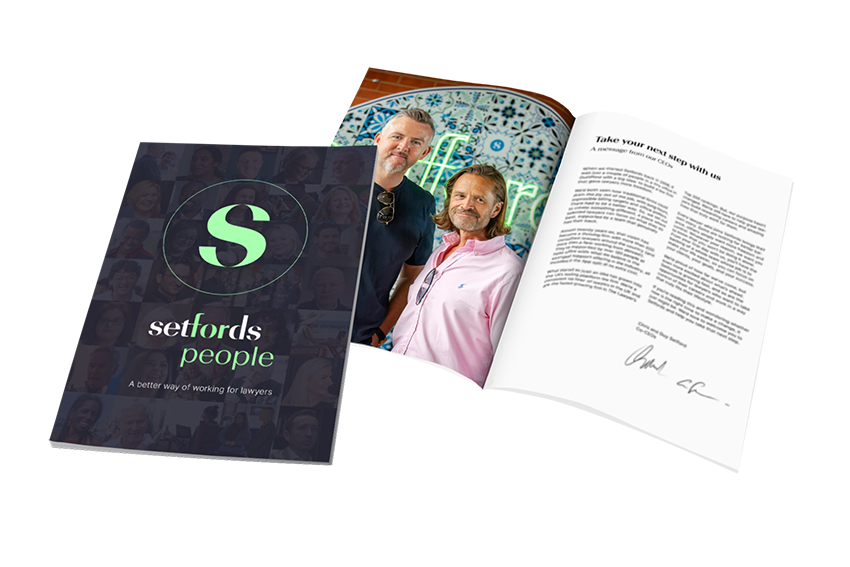
Want more information? Download our guide to help you decide if consultancy is the right move for you.
What does being a consultant lawyer actually mean?
A consultant lawyer is a qualified legal professional who operates on a self-employed basis, under the umbrella of a platform law firm that provides infrastructure and support. Unlike traditional employment, where you receive a salary and the firm directs your work, consultancy sits somewhere between employment and running your own practice.
As a consultant, you work under your own practising certificate, have greater control over which clients you accept and how much work you take on, and typically receive a higher percentage of your billings. However, this comes without the guaranteed monthly salary, benefits package, or work allocation that traditional employment provides.
It’s important to distinguish consultancy from sole practice as well. While sole practitioners run entirely independent practices and handle all aspects of regulation, compliance, and administration themselves, consultant lawyers benefit from the infrastructure, systems, and support provided by their affiliated firm, while keeping much of the flexibility of running your own business.
Why lawyers choose consultancy
Flexibility
For many lawyers, the primary appeal of consultancy is more control. You have significantly more say over which clients and matters you accept, your working hours and location, your fee structures, and how you balance work with personal commitments.
Work-life balance
Consultancy offers genuine opportunities for work-life balance, appealing to lawyers with caring responsibilities, those who want to pursue interests outside their careers, those who prefer working outside the traditional office structure, or those looking to wind down gradually toward retirement.
Financial benefits
The financial picture for consultant lawyers is often more rewarding than traditional employment. With the right client base and strong billing capacity, consultants can earn significantly more than in salaried roles. However, your earnings depend directly on the work you generate and complete, requiring financial planning and tolerance for uncertainty.
The realities to consider
Consultancy offers plenty of perks, but there are a few things you need to consider before you decide if it’s right for you. The key factors include:
Income variability
Unlike a regular monthly salary, your earnings are directly tied to the work you bring in and complete. Some months will be busy; others may be quieter. New client acquisition takes time, and there will be periods where you’re investing effort in business development without immediate financial return.
It’s recommended to have a financial cushion to cover lean periods, budgeting and tax planning, comfort with uncertainty (especially when starting out), and realistic expectations about income in the first year.
Business development responsibility
As a consultant, you’re primarily responsible for generating your own work. This means actively maintaining and developing client relationships, networking consistently and strategically, marketing your expertise, and converting opportunities into instructions.
While many consultant law firms, like Setfords, provide new business leads and marketing support, these should be seen as a bonus rather than the foundation of your practice. You need to be comfortable with proactive business development to have the best chance of success.
Is consultancy right for you?
Before making the move, honest reflection is essential. Here are some questions to ask yourself across several key areas:
- Financial readiness: Do you have a financial cushion? Are you comfortable with income variability at first? Have you accurately calculated what you need to earn?
- Work style and personality: Do you thrive with flexibility or prefer structure? Are you self-motivated? How do you feel about working outside of an office environment?
- Client base and business development: Do you have an existing network? Are you confident in your ability to generate business? Do you enjoy networking?
- Career and professional factors: What are your long-term goals? Are you at the right career stage? Do you have the expertise and reputation to attract clients?
- Lifestyle and personal considerations: Why are you considering consultancy? What are your non-negotiable priorities? How do you handle stress and uncertainty?
There are no right or wrong answers. The point is to be honest with yourself about your circumstances, motivations, and readiness.
Making an Informed Decision
Becoming a consultant lawyer offers an exciting alternative to traditional employment, with greater flexibility and the opportunity to build a practice on your own terms, with potentially significant financial rewards. However, it’s not always the easy option, nor a universal solution.
It requires experience, confidence, business development capability, financial resilience, and independence. For some lawyers, consultancy is transformative, enabling them to take control of their careers and lives. For others, it doesn’t align with their personal or professional goals.
The legal industry is broad enough to accommodate many different ways of practicing and building a career. The key is finding the one that works for you.
Want to explore consultancy in more depth? Download our comprehensive guide, “A Guide to Consultancy: Is Working as a Consultant Lawyer Right for You?” for detailed insights, a reflective checklist to assess your readiness, and key questions to ask yourself before making this important career decision.